
Mughal gardens were built by the emperors between the 16th and 18th centuries. They are known for their symmetry and balance.
The design comes from the Persian Charbagh style, which divides a space into four parts.
In these gardens, you’ll see flowing water channels, terraced lawns, fountains, and colorful flowers.
Together, they create a picture of paradise on earth. Some of the most famous examples include Shalimar Bagh and Nishat Bagh in Kashmir, as well as the gardens of the Taj Mahal in Agra.
Now picture this. You’re walking through one of these gardens. The air is filled with the sound of fountains. Roses bloom in neat lines around you. The pathways guide your eyes toward snow-covered mountains in the distance.
Now pause.
You’re not in a modern resort. You’re standing in a Mughal garden, an idea planted centuries ago by emperors who wanted paradise on earth.
I still remember the first time I visited Shalimar Bagh in Kashmir. The cool mist from the fountains brushed my face, and for a moment, I felt as if time had folded back. That’s the magic of Mughal gardens.
They don’t just show you plants and water. They show you history, art, power, and faith all in one frame.
And here’s the twist: these gardens weren’t built only for emperors. They were made for people like you, centuries later, to walk in, to sit under a chinar tree, and to feel connected with something timeless.
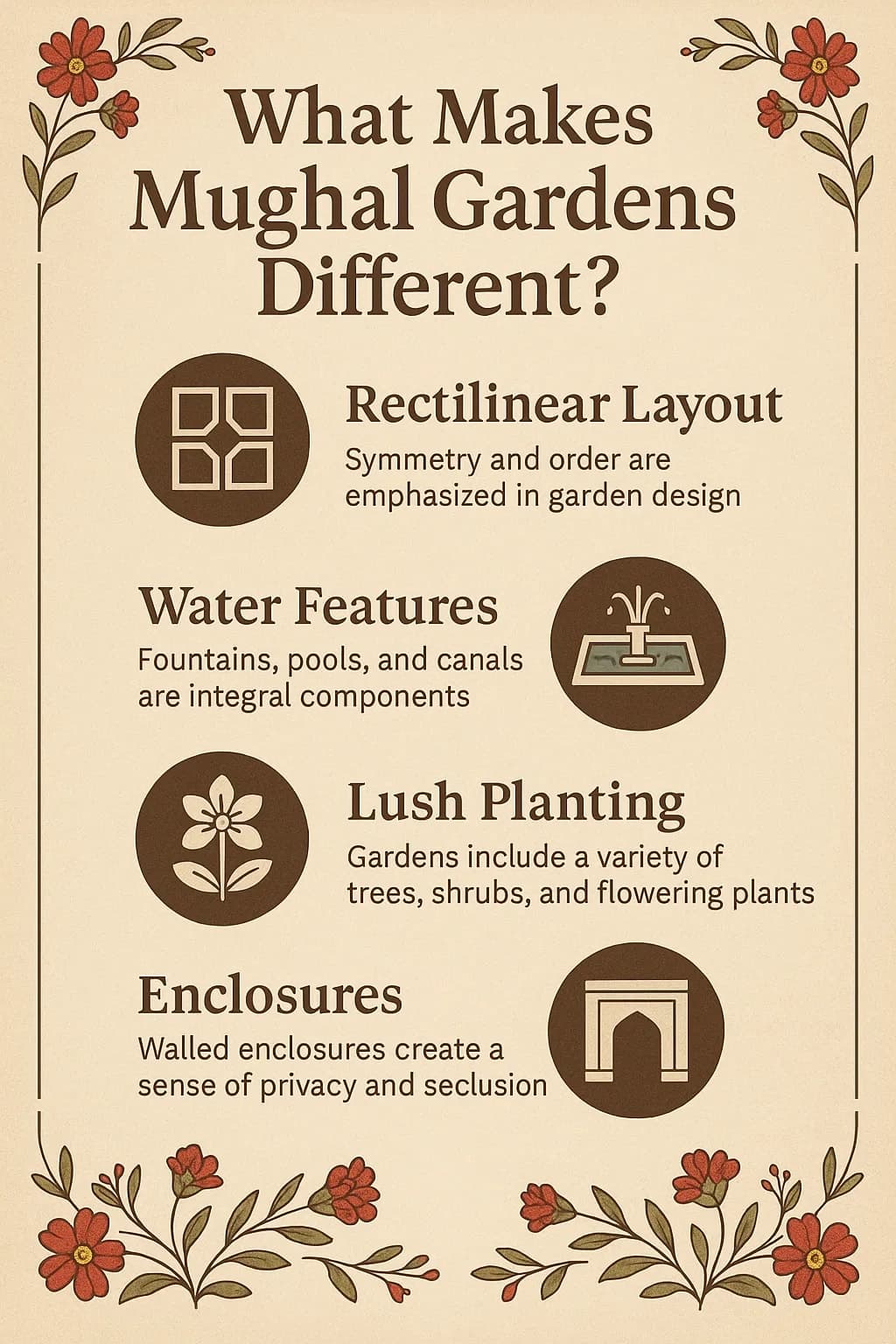
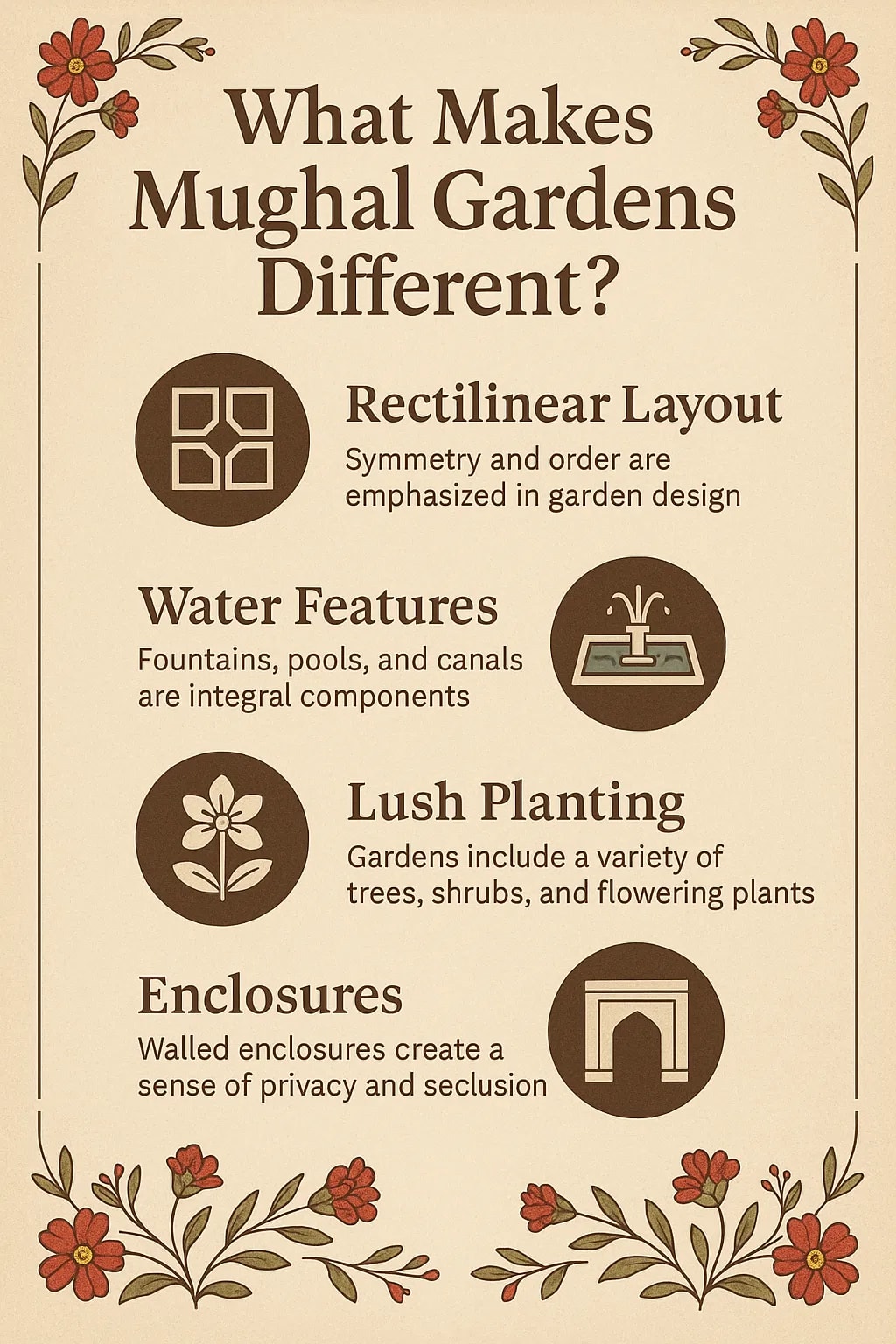
What Makes Mughal Gardens Different?
If you’ve strolled through modern city parks, you’ll notice the difference right away. Parks often feel open and casual, with paths winding wherever space allows. Mughal gardens aren’t like that.
They’re not random patches of green. They’re carefully planned masterpieces built on a design called the Charbagh, a four-part layout inspired by Persian gardens.
Picture this: the garden is divided into four equal parts by water channels. These channels aren’t just practical, they’re mirrors.
They reflect the sky above, the chinar trees around you, and sometimes even the domes of nearby palaces or shrines. When you stand beside them, you feel as though the earth and the heavens have been stitched together in a single frame.
In Islamic tradition, this design symbolized the four rivers of paradise of water, milk, honey, and wine.
For the Mughals, recreating this on earth was more than beauty. It was spiritual. A Mughal garden wasn’t only a retreat for the body but also for the soul.
Why go to such lengths? Why not build a simple orchard or a park? The answer lies in how the Mughals viewed power and life itself.
Gardens were a reflection of the empire. They showed order in the middle of chaos, balance in the middle of uncertainty, and beauty that could endure through generations.
Think about it. When Jahangir built Shalimar Bagh for Noor Jahan, he wasn’t only giving her a gift. He was building a vision of love that still speaks to you centuries later.
When Shah Jahan placed the Taj Mahal inside its Charbagh, he wasn’t only framing a monument. He was inviting every visitor to walk through paradise before reaching the symbol of eternal love.
So when you step into a Mughal garden today, you’re not just seeing plants, water, and stone. You’re stepping into a place where nature and architecture come together.
Every fountain and every pathway tells you the same thing. Heaven can be found here on earth, and it’s made for you to walk through.
Read More On: Gulmarg Hotels: Where Comfort Meets Adventure
Walking Through History: Gardens Across the Empire

Kashmir: The Crown of Mughal Gardens
The emperors poured their hearts into Kashmir. Each garden here is a chapter of love, power, and paradise.
- Shalimar Bagh – Garden of Love
- Built by Emperor Jahangir in 1619 for his queen, Noor Jahan.
- Designed in three terraces:
- Public terrace for common visitors.
- Middle terrace for nobles and courtiers.
- Upper terrace for the emperor and his queen.
- Public terrace for common visitors.
- Fountains, canals, and chinar trees create a rhythm that pulls you inward.
- Every step feels like entering a more private world of the royals.
- Built by Emperor Jahangir in 1619 for his queen, Noor Jahan.
- Nishat Bagh – Garden of Joy
- Built by Asif Khan, Noor Jahan’s brother.
- Famous for its twelve terraces, rising like steps into the sky.
- Offers sweeping views of Dal Lake with the Zabarwan Mountains as a backdrop.
- Perfect for sunsets, strolls, and photography.
- Each terrace feels like a new stage in a story.
- Built by Asif Khan, Noor Jahan’s brother.
- Chashme Shahi – The Royal Spring
- A smaller but sacred garden, built around a natural spring.
- Locals believe the water here has healing properties.
- Terraces and fountains make it intimate, almost like a secret retreat.
- Ideal for those seeking calm and connection with nature.
- A smaller but sacred garden, built around a natural spring.
Delhi: The First Experiments
Delhi gave Mughal architects their first opportunity to try Charbagh layouts.
- Humayun’s Tomb Garden
- One of the earliest Charbagh gardens in India (1572).
- Commissioned by Hamida Banu Begum, Humayun’s widow.
- Four water channels divide the garden into symmetrical sections.
- The greenery frames the tomb, guiding the eye toward the central dome.
- Represents the fusion of Persian design with Indian soil, setting the stage for later masterpieces.
- One of the earliest Charbagh gardens in India (1572).
Agra: The Jewel of Symmetry
Agra perfected what Delhi began.
- The Taj Mahal Garden
- The Taj Mahal isn’t complete without its Charbagh garden.
- The central water channel reflects the white marble, making the Taj look like it floats.
- Pathways shaded by trees invite slow, reflective walks.
- Every step through the garden is meant to prepare your soul for the monument.
- Shows how the Mughals designed journeys, not just destinations.
- The Taj Mahal isn’t complete without its Charbagh garden.
Lahore and Beyond
Mughal influence spread outside India as well.
- Shalimar Gardens of Lahore
- Built by Shah Jahan in 1641.
- Known for its terraced levels, elaborate fountains, and marble pavilions.
- Echoes the Kashmir gardens but adapts them to Punjab’s landscape.
- Highlights how Mughal garden philosophy crossed regions and cultures.
- Built by Shah Jahan in 1641.
Experiencing Mughal Gardens Today
When you walk into a Mughal garden today, the first thing that strikes you is the quiet order. It isn’t wild or random like a forest.
Everything feels placed with intention, as if the trees, fountains, and pavilions have been waiting for centuries just for you to arrive.
Read More On: Living on a Houseboat: Pros, Cons, and Essential Tips
What to Look For When You Visit
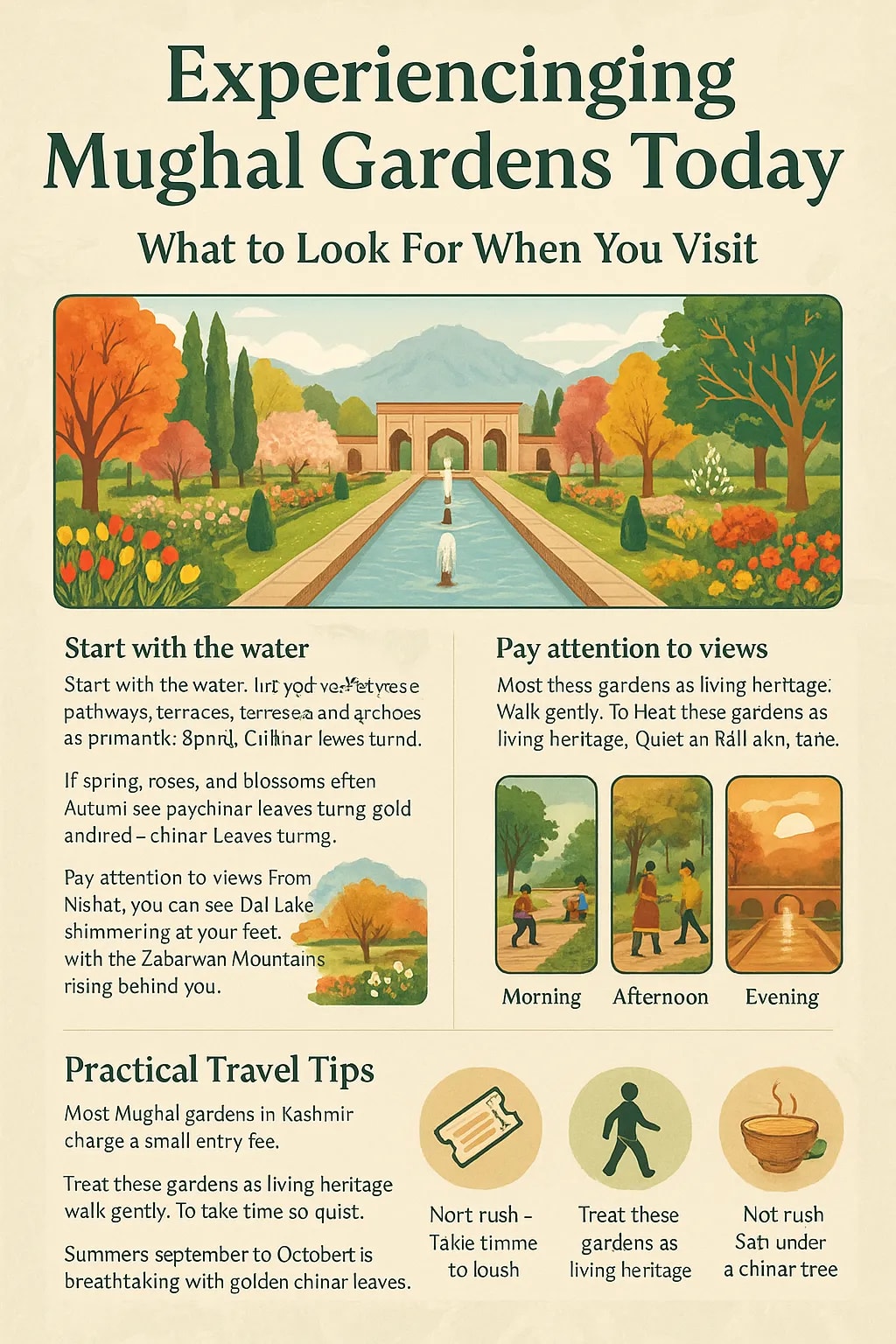
Start with the water. Stand by the main canal in Shalimar Bagh or Nishat, and watch how it catches the sky. Notice how the fountains break the reflection into ripples, adding a rhythm that feels almost musical.
Then lift your eyes toward the terraces, the carved stone pathways, and the arches that frame the garden like a painting. These details aren’t there by chance; they’re part of the Mughal vision of paradise.
If you visit in spring, the gardens turn into canvases of color. Tulips, roses, and blossoms fill the air with fragrance, while chinar trees begin to stretch their green canopies. In autumn, the mood shifts completely.
The chinars burn gold and red, carpeting the walkways in fiery leaves. Every season gives you a new lens through which to see the same garden.
Pay attention to the views. From Nishat, you can see Dal Lake shimmering at your feet with the Zabarwan Mountains rising behind you. From Shalimar’s upper terraces, the garden stretches out like a royal diary written in stone and water.
Even in smaller gardens like Chashme Shahi, the sound of the natural spring adds a kind of intimacy you won’t find anywhere else.
Read More On: Kashmir Day: Facts, Timeline & Ways to Show Solidarity
Best Times to Visit
Mornings are serene. The light is soft, the air is cool, and the gardens feel almost private. It’s the perfect time if you love photography or if you simply want a quiet stroll before the crowds arrive.
Afternoons are warmer, but the fountains and shade of the chinars make them bearable. If you enjoy lively atmospheres, this is when you’ll see families picnicking and children playing.
Evenings bring their own charm. As the sun sets over Dal Lake, the golden light washes over the gardens, turning everything into a painting. It’s also the most romantic time to sit quietly and watch the fountains sparkle in the fading glow.
As for seasons, spring (April to June) is full of blossoms, while autumn (September to October) is breathtaking with golden chinar leaves.
Summer is pleasant but can get crowded, while winters are stark and quiet, a different beauty altogether if you don’t mind the chill.
Read More On: Packing Tips for Travel: Essentials You Shouldn’t Forget
Practical Travel Tips
Most Mughal gardens in Kashmir charge a small entry fee, usually between ₹20 and ₹50 per person. Tickets are sold at the gate, and the revenue supports maintenance. Hiring a local guide is worth it if you want to hear the hidden stories, like which terrace was reserved for the emperor, or why a certain spring was believed to be sacred.
Remember that these gardens are living heritage. Walk gently on the paths, avoid plucking flowers, and keep the space clean.
Locals treat these gardens as part of their identity, not just tourist sites, so respecting that culture enriches your own experience too.
If you want the full experience, take your time. Don’t rush from one garden to the next. Sit under a chinar tree, watch children play, sip kahwa from a nearby vendor, and let the space sink in. The Mughals built these gardens to slow you down. Permit yourself to do exactly that.
Read More On: Deep Dive into Wular Lake: Asia’s Freshwater Gem
The Heartbeat of Mughal Garden Design
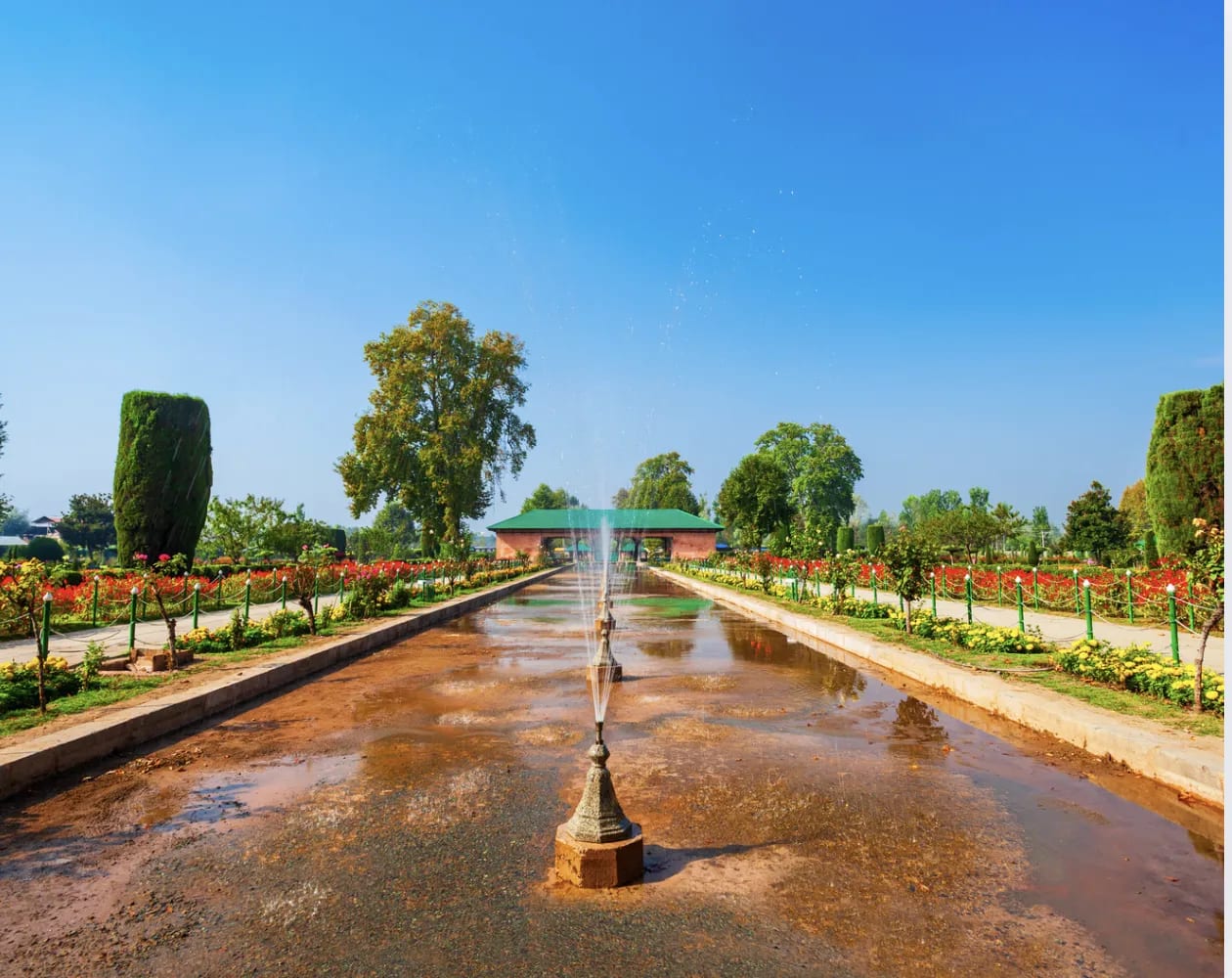
When you step into a Mughal garden, it doesn’t feel accidental. Every element, water, trees, and pathways, has a purpose. Together, they form the heartbeat that keeps the garden alive centuries later.
- Water: The Soul of Paradise
- Flowing water was central to every Mughal garden.
- Canals, fountains, and pools weren’t just for beauty; they cooled the air in summer and created music through movement.
- In Islamic tradition, flowing water symbolized purity, abundance, and eternal life.
- Reflections in the water doubled the beauty of domes, trees, and skies, all appeared twice.
- Even today, when you hear the splash of a fountain in Shalimar or Chashme Shahi, you feel the garden breathe.
- Flowing water was central to every Mughal garden.
- Trees and Plants: Living Symbols
- The Mughals didn’t plant at random. Each tree and flower had a role:
- Chinar trees – wide shade, dramatic colors in autumn.
- Roses and jasmines – fragrance to enchant visitors.
- Fruit trees – pomegranates, apples, and cherries symbolized abundance.
- Chinar trees – wide shade, dramatic colors in autumn.
- Gardens were meant to please all five senses: sight, smell, sound, taste, and touch.
- Sitting under a chinar or smelling roses in Nishat Bagh connects you with the same experiences emperors once enjoyed.
- The Mughals didn’t plant at random. Each tree and flower had a role:
- Symmetry and Geometry: Order in Chaos
- Every Mughal garden follows geometry and balance.
- Pathways divide spaces with mathematical precision, creating a sense of order.
- This wasn’t just aesthetic; it reflected a philosophy of harmony between humans, nature, and the divine.
- The Charbagh layout ensured you never felt lost; your eye always finds balance, no matter where you stand.
- Even today, symmetry gives you peace; it slows your mind in a world that’s always rushing.
- Every Mughal garden follows geometry and balance.
- Architecture as Part of Nature
- Gardens weren’t separate from buildings; they worked together.
- Marble pavilions, carved arches, and baradaris (open halls) gave shade while framing views.
- Stone pathways guided footsteps, while fountains drew your gaze toward palaces or mountains.
- You don’t just see architecture in a Mughal garden; you see how it blends with earth, water, and sky.
- Gardens weren’t separate from buildings; they worked together.
- Experience Over Ornament
- For the Mughals, gardens weren’t simply about decoration.
- They were meant to transport you into a state of calm, reflection, and joy.
- When you walk slowly along the water channels or rest under a tree, you’re not looking at art, you’re living inside it.
- For the Mughals, gardens weren’t simply about decoration.
Quick Pause Here’s Something for You
Dreaming of walking through Shalimar Bagh or sitting by Dal Lake surrounded by Nishat’s terraced gardens?
Plan your Kashmir trip with us today, and we’ll help you create an unforgettable itinerary around the Mughal gardens and other must-see attractions.
Stories Hidden in Stone and Water

Noor Jahan’s Influence
When you walk into Shalimar Bagh, remember this: Noor Jahan wasn’t a silent queen. She shaped policies, art, and gardens. Many believe her love for design made Jahangir invest so deeply in Kashmir’s landscapes.
Aurangzeb’s Different Taste
Not all Mughal emperors loved gardens equally. Aurangzeb, for example, focused less on them. His austerity meant fewer gardens were built during his reign. And that contrast shows you how personal vision shapes heritage.
Gardens as Public Spaces
Over time, many Mughal gardens became places for ordinary people. Families picnicked. Travelers rested. Think about it, you’re not just a visitor today. You’re part of a centuries-long tradition of people using these spaces for joy.
Read More On: Best Kashmiri Tea Brands & Where to Buy Ingredients
Challenges and Conservation

As timeless as Mughal gardens feel, they’re not untouched by the world around them. If you walk through Shalimar or Nishat today, you’ll still find fountains that sparkle and trees that sway, but look closer and you’ll notice the scars of time. Some fountains no longer work. Stone steps have worn down under centuries of footsteps.
The delicate carvings that once spoke of royal elegance now show the weight of weather, pollution, and neglect.
Part of the challenge comes from the sheer passage of time. These gardens are more than four hundred years old, and keeping them alive requires constant care.
Yet the demands of modern life often outpace the quiet needs of heritage. Rising tourism brings joy and income, but it also adds pressure more feet on the paths, more waste to manage, and more strain on delicate systems designed for emperors, not crowds.
Climate change adds another layer of struggle. Kashmir’s seasons, once steady and predictable, now shift in ways that the Mughals could never have imagined. Longer dry spells put stress on fountains and water channels.
Unseasonal rains damage plants and erode soil. Even the chinar trees, symbols of strength and endurance, feel the pressure of a warming world.
There’s also the human factor. Cities expand, and sometimes heritage takes a backseat to modern development.
Without consistent funding and awareness, the survival of these gardens can feel uncertain. Some are well cared for, others wait for attention that never comes quickly enough.
But it’s not all lost. Conservation efforts are underway. Teams of historians, architects, and local caretakers are working to restore fountains, clean water channels, and protect the ancient chinars.
Initiatives supported by UNESCO and the Archaeological Survey of India have helped breathe new life into parts of these gardens.
And every time travelers like you visit responsibly when you respect the pathways, avoid littering, or support local guides, you become part of that restoration too.
That’s the beauty of heritage. It doesn’t just belong to emperors or historians. It belongs to everyone who walks through it. The Mughal emperors may have built these gardens, but their future depends on us.
When you wander through Shalimar, Nishat, or Chashme Shahi, remember that you’re not only enjoying history.
You’re also carrying the responsibility of keeping paradise alive for the next visitor, the next generation, the next dreamer who will sit under a chinar tree and fall in love with Kashmir’s timeless magic.
Final Thoughts
The legacy of Mughal gardens isn’t locked in history books. It’s alive every time you walk through them, breathe their air, and feel their water on your skin.
When you stand in Nishat Bagh looking at Dal Lake, or in front of the Taj Mahal watching its garden frame perfection, you’re not just a visitor. You’re a participant in a story that began centuries ago.
And maybe, just maybe, you’ll walk away inspired to bring that same harmony, order, and beauty into your own world.
Check out our recent blog on Places to Visit in Kashmir: A Complete Travel Guide
Frequently Asked Questions
Yes, you can. Shalimar Bagh, Nishat Bagh, and Chashme Shahi are located close to Dal Lake, so it’s easy to cover them in one day with a guided itinerary. Many travelers prefer to spread visits across two days to enjoy each garden at a relaxed pace.
Most Mughal gardens charge a small entry fee, usually between ₹20–₹50 per person. This helps with maintenance and conservation. Children often have discounted rates, and tickets can be purchased on-site.
Early mornings and late afternoons are best. The light is softer for photography, the crowds are smaller, and the gardens feel more peaceful. Evening visits also give you stunning sunset views over Dal Lake.
Yes. Many gardens like Nishat Bagh and Shalimar Bagh have wide pathways that are stroller- and wheelchair-accessible, though some terraced sections may require extra assistance. Families often enjoy picnics in designated areas.
Absolutely. Guided tours give you insider stories about emperors, queens, and architects who shaped these gardens. At KashmirHolidays.co, we arrange private tours where a local guide explains history while you enjoy the beauty without rushing.